Mosaic theory, universal surveillance and unlimited recordkeeping

‘“Mosaic theory” describes a basic precept of intelligence gathering: Disparate items of information, though individually of limited or no utility to their possessor, can take on added significance when combined with other items of information.’ [1]

Mosaic theory was what caused intelligence organisations like Australia’s ASIO (Australian Security and Intelligence Organisation) in the mid 20th century to record what seemed like incredibly mundane activities and communications of what were then called ‘persons of interest’. For example, continuous surveillance of the doorway to Sydney’s Communist party headquarters – for decades. What was recorded now tells us more about the changing state of fashion than it ever told us about the (hardly dangerous) activities of those who came and went. But for ASIO, the game was to gather as much as they possibly could. Not only to attempt to build a bigger picture in line with mosaic theory, but more prosaically, to keep themselves in work in the relatively unexciting backwater – in espionage terms – that Australia was in the 1950s, 60s and 70s.

As we can see now from the ASIO archives, these surveillance activities produced mammoth quantities of records – in the form of telephone conversation recordings and transcripts, photographs, film and copies of press clippings. These were carefully gathered, collated and filed. And then, for the most part, the information sat unloved in the files unless some alert intelligence officer happened to think of some way to link a new discovery to something previously recorded. They simply did not have the tools to analyse the information they had.

Mosaic: From AEJHarrison's photostream http://www.flickr.com/photos/28385889@N07/

Mosaic: From AEJHarrison’s photostream
Continue reading

Posted in Post | Tagged , , , | Leave a comment

Did you have any idea? Video series in support of WikiLeaks and Julian Assange

Award winning Sydney based documentary filmmaker Cathy Vogan has been filming and interviewing Australians about why they support WikiLeaks and Julian Assange. Her subjects have included Australian Greens Senator Scott Ludlam, Media Watch presenter Jonathan Holmes and Australia’s first female news anchor Mary Kostakidis, also of the Sydney Peace Foundation. There are more to come. I was really pleased to add my voice as an archivist and WikiLeaks supporter. WikiLeaks and Julian Assange need our support at this critical time – critical for Assange personally, but also because of the promise for change that we are seeing now in the way society decides it wants to use and share information for social justice outcomes and to demand accountability of the powerful.

DID YOU HAVE ANY IDEA? with Cassie FINDLAY from CaTV on Vimeo.

Transcript:

My name is Cassie Findlay and I am an archivist, working primarily with digital records. Continue reading

Posted in Post | Tagged , , , , | Leave a comment

The work of Peter Scott, an overview

By Kate Cumming

At the recent Recordkeeping Roundtable event ‘Drawing insight and inspiration from tradition: The Australian Series System and digital recordkeeping’ I spoke about the history of the series system. Referencing Terry Cook (and Shakepeare!), I argued that ‘What is past is prologue’; that is we need to understand our past in order to move into the future. Continue reading

Posted in Post | Tagged , , , , , , | Leave a comment

Digital recordkeeping and the series system

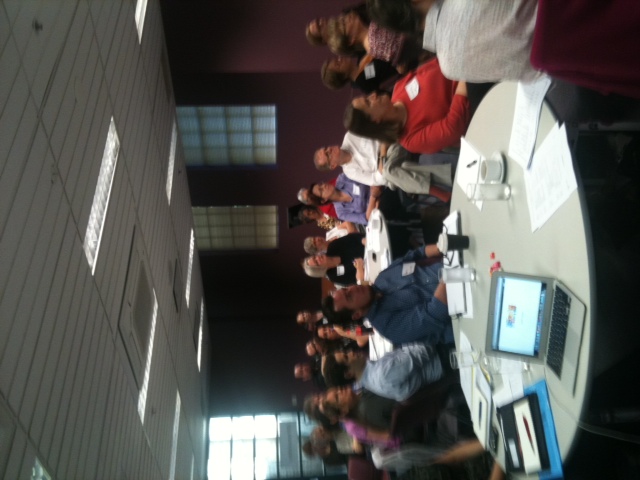
On Friday 25 October, 40 archivists from across Australia and New Zealand attended our workshop, Drawing insight and inspiration from tradition: Digital recordkeeping and the Australian series system.

The workshop was inspired by the release of the landmark Australian Society of Archivists’ publication, The Arrangement and Description of Archives Amid Administrative and Technological Change – Essays and Reflections By and About Peter J Scott. (See http://www.archivists.org.au/onlinestore/publications-hardcopy for more information on the book.)

We had such a fantastic day. The objective was to explore the application of the Australian series system to digital recordkeeping. By revisiting fundamental archival principles and insights, the workshop sought to explore how the series system can be reinvented to meet contemporary recordkeeping challenges. Continue reading

Posted in Uncategorized | Tagged , , , , , , | 1 Comment

“El Derecho a Saber” (“The Right to Know”)

How recordkeeping systems can reveal the organisation of oppression

“On March 25, Human Rights Ombudsman Sergio Morales’ wife, Gladys Monterroso, was abducted by unknown assailants and released some 15 hours later after she was beaten and raped. Early indications suggested that the kidnapping may have been intended to intimidate Morales into backing off of his efforts to highlight and investigate human rights violations committed during Guatemala’s internal conflict. Specifically, the attack could have been designed to stop him from making public sensitive records from the Historic National Police Archives. This potential link led the International Commission Against Impunity in Guatemala (CICIG) to take on the investigation.”

Date: 06/08/2009
Refid: 09GUATEMALA539
Origin: Embassy Guatemala
Released: 30/08/2011

http://wikileaks.org/cable/2009/06/09GUATEMALA539.html

This story has continued, with, fortunately, very positive results. And it reveals much to us about the nature of evidence en masse – how large collections of records can be necessary if we are to fully understand the systems and governance that supports the actions of abusive or just societies. Continue reading

Posted in Post | Tagged , , | Leave a comment

WikiLeaks and the politics of information

On September 1 Recordkeeping Roundtable co-founder Barbara Reed gave a lecture at Monash University at the invitation of Centre for Organisational and Social Informatics on ‘Wikileaks and the politics of information’.

In the talk, Barbara covers a wide range of issues relating to the custodianship, management and dissemination of the highly politically charged sets of records that have been submitted to WikiLeaks, and draws out from these the challenges for our profession in considering our understandings of matters such as control, ownership, authenticity and access to information. Importantly, Barbara places her reflections on WikiLeaks in the broader political context, involving as it does threats from governments, financial blockades and censorship (for example, in the case of the Library of Congress refusing to allow online access to WikiLeaks materials in their reading rooms). In addition to this ‘macro’ context, Barbara also valiantly (and even-handedly) explores the events leading up to the release of CableGate2, which had occurred only days before her talk.

Some of the parallels between WikiLeaks’ work and our own in recordkeeping that Barbara particularly notes include the notion of undeniability and proof; that by releasing so much information (evidence), no-one can deny what is actually going on. She also urges us to consider what we, as recordkeeping professionals, can take from the crowdsourcing methods employed by WikiLeaks to encourage pulling information from the records and tagging important information via Twitter, as has occurred  with #wlfind, as well as using records data in creative ways via visualisations, as have been generated by media partners, supporters and other creative developers.

You can access audio or video of Barbara’s talk here: http://www.infotech.monash.edu.au/research/centres/cosi/events/2011/wikileaks.html

Note: The talk itself is of about 45 minutes’ duration, followed by a Q&A session. Audio option is good, seems to be something odd going on with the video file.

Posted in Post | Tagged , , , | Leave a comment

Report on ‘Hacking the archives: Archival description in an online world’

How do we ensure that “meaning as well as content lies at the end of the road to discovery?”

On Wednesday August 24 we got together to talk about the question of how we can ensure that “meaning as well as content lies at the end of the road to discovery?” Our speakers were Chris Hurley, Tim Sherratt and Richard Lehane.

Recordkeepers strive to contextualise, authenticate and preserve evidence. They create detailed descriptive tools and infrastructures as means to describe and manage records and to facilitate their access and use through time.

But are recordkeepers losing the battle to translate the meaning and value of this skill to an online world? As Chris Hurley asks, in the rapidly expanding information universe, are carefully contextualised archival collections at risk of ‘becoming just another quarry for digitised content, often indistinguishable, depending on how it has been googled, from other information resources available on the net’?

Hacking the archives 24 Aug 2011

L-R: Kate Cumming (MC), Tim Sherratt, Richard Lehane, Chris Hurley

It was a brilliant evening, with three unique but complementary perspectives from our speakers. As we usually do, we recorded the speakers for a podcast but *very annoyingly* the recording device ran out of memory 10 minutes in – something we only discovered when it was too late. Sorry, all, & we are looking at upgrading our equipment.

We do, however, have a copy of Chris’s presentation: Hurley Description in an online world (PDF, 260 KB), and you can check out  Tim’s work here: http://discontents.com.au/. State Records NSW’s Open Data project and API, which Richard spoke about, are here: http://data.records.nsw.gov.au

I also live tweeted the evening’s proceedings as @RkRoundtable, here’s the Tweetstream: Continue reading

Posted in Report, Uncategorized | Tagged , , , , , | 1 Comment

Revealing or repressing the archive as a litmus test for a healthy society: An analysis of #WLfind cables + #Archives

We take for granted that there exist, somewhere in society, macro-actors that naturally dominate the scene… The problem is that these entities could not exist at all without the construction of long networks in which numerous faithful records circulate in both directions, records which are, in turn, summarized and displayed to convince.

– Bruno Latour, Visualization and Congnition: thinking with eyes and hands, Knowledge and Society, 1986.

Authoritarian regimes give rise to forces which oppose them by pushing against the individual and collective will to freedom, truth and self realization. Plans which assist authoritarian rule, once discovered, induce resistance. Hence these plans are concealed by successful authoritarian powers. This is enough to define their behaviour as conspiratorial.

– Julian Assange, ‘State and Terrorist Conspiracies’, iq.org, November 10, 2006.

Recordkeeping and power are inextricably bound together. The act of making a record and how it is kept can shape the current and future reality for an individual or group – in some cases to oppress or control, in some to liberate. This was strikingly evident in the stories emerging from WikiLeaks’ latest batches of cable releases where they touched on recordkeeping and archives. Continue reading

Posted in Post | Tagged , , | Leave a comment

Revolutionary walls of memory

Accountability - Total Revolution | Purification - Total Revolution

Accountability - Total Revolution | Purification - Total Revolution

This week in Al-Akhbar English, Sayyid Mahmoud reports on the work of artist Ahmad al-Labbad and his efforts to capture the public art which appeared all over Cairo’s Tahrir Square and elsewhere during the January 25 revolution – “the largest open art exhibition the world has ever known.”

For Labbad, the the graffiti, symbols and placards were valuable records of the revolution – and ones that reflected the people’s experience. In Mahmoud’s words: “The graffiti glowed brilliantly from the minds of Egyptians who joined in the revolution.” Not only did Labbad photograph the works but he has also categorised them according to their subject and date.

And it’s just as well he did. In his words:

I imagined that the revolution would spur us to reconsider the value of the idea of accumulati. It is unfortunate that Tahrir Square was subjected to a frightful operation that erased the artifacts of the revolution. The removal of all the paintings and writings that appeared in the seventeen days prior to Mubarak’s stepping down were done under the pretense of cleaning up. Magically, all forms of graffiti were removed from the walls. Thus, under the charge of ‘beautifying the city,’ the authorities launched an attack on history.

Continue reading

Posted in Post | Tagged , , , , | Leave a comment