Archivists, librarians and WikiLeaks – Part 2

A few weeks back I reported in this blog on the efforts of Tom Twiss and the rest of the Social Responsibilities Round Table group in the American Library Association to have three resolutions passed by the ALA’s general membership meeting relating to WikiLeaks, Bradley Manning and the importance of free speech, free press and the openness and accountability of government.

Now closer to home it’s great to be able to report on another librarian who is making the connection between his work and the mission of WikiLeaks, the newly appointed State Librarian of New South Wales, Dr Alex Byrne.
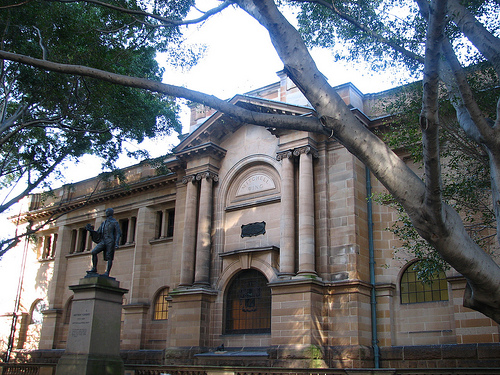
State Library of NSW Mitchell Wing: Kate's Photo Diary http://www.flickr.com/photos/lightcliff/

Dr Byrne has contributed an article in the latest issue of Archives and Manuscripts, the Australian Society of Archivists’ journal, a scan of which is provided below. The article, ‘Wikileaks and Web 2.0: privacy, security and other things that keep me awake’, challenges some of the information sciences’ long held assumptions about privacy and confidentiality, security and integrity and authority – using the rise of social media and other web 2.0 technologies and WikiLeaks as two examples of the seismic shifts in expectations and possibilities in these areas.

Of course I’d recommend reading the whole piece but here are a few observations from Dr Byrne that touch on many of the issues that we explored at our Roundtable Wikileaks event in March, which Tom and his colleagues at the ALA are concerned with, and which I believe any information professional will ignore at his or her peril.

Regarding the CableGate releases:

“But the disclosures have other lessons for memory institutions. Above all, they forcefully demonstrate that there are new agencies entering into the management and dissemination of records on a large scale. .. WikiLeaks has introduced a new agency, one which will accept leaked documents anonymously, assess them, possibly redact elements, compile guides and summaries, and publish facsimiles of the documents on a public website for all to see. And that access is guaranteed against blockage or legal prohibition by the mirroring of WikiLeaks on 1,426 sites, as at the end of 2010.

Meanwhile, government archives continue to manage records in accordance with accepted practice and protocols and the application of 25 year, 30 year or longer embargoes on access. The contrast is stark and to the detriment of the official archives in the face of widespread expectations of openness and participation. No amount of huffing and puffing by leaders of government or officials will reverse those growing expectations.”

Byrne also makes some great points about the difference we see now between the ubiquity of online information, and expectations of access as compared with what Archives New Zealand has termed ‘practical obscurity’ – that is, the negative effect on the use and effectiveness of information as a result of being kept in physical form in boxes in a repository, perhaps poorly indexed and almost certainly in an inconvenient geographic location (owing to the need for large areas of space). When you think of what could be achieved by making legacy archival materials accessible online in the way that WikiLeaks does – dependent of course in the government sector upon sizeable boosts to archives institutions’ budgets – possibilities for citizen engagement and understanding of their governments expand exponentially.

Read the full article here: ‘Byrne, Alex ‘WikiLeaks and Web 2.0’ Archives and Manuscripts, Vol 29 No 1 May 2011 (PDF, 7.32 MB)

Find out more about Archives and Manuscripts, the journal of the Australian Society of Archivists, here:  http://www.archivists.org.au/resources/archives-manuscripts-journal With thanks to the Editor, Sebastian Gurciullo, for permitting us to make the full text of the article available.

Posted in Post | Tagged , , | Leave a comment

Drawing insight and inspiration from tradition: The Australian Series System and digital recordkeeping – An interactive workshop

Archival institutions the world over are battling to reinvent their traditional processes, practices and systems in order to deal with the scale, complexity and richness of contemporary digital records.

Come and join speakers from Archives New Zealand, the Public Record Office Victoria, State Records NSW and the University of Sydney, as well as prominent theorists Chris Hurley and Barbara Reed, to explore how archival processes and responsibilities can be reformulated to cope with the realities of the digital world.

Image: Luc Viator

The timing of this event is critical. There is no further time for reflection. Collective solutions to these archival challenges must be developed and implemented now before the problems become insurmountable.

Topics to be covered include:

  • How we can go about recapturing the opportunities presented by Peter Scott’s original articulation of the series system
  • What problems are those implementing digital archives encountering?
  • How can archival description be scaled to generate context out of chaos?
  • How can entities and relationships be defined to enable meaningful and flexible description to evolve through time?
  • How should item level description be managed to incorporate information-rich business metadata?
  • How can archivists collaborate better to develop cooperative solutions?
  • Can the problem be dealt with before it occurs? Strategies for encouraging better description in the record creation environment

Help to reinvent tradition and register now to become part of this challenging but professionally important day.

  • Where: ATP Innovations Seminar Room, National Innovation Centre,Australian Technology Park, Redfern (map and directions)
  • When: Friday 21 October, 8:30am – 5:30pm
  • Cost: $150; $130 for ASA members – including GST (covers the workshop, catering and celebratory drinks at the end of the day)

Payment:

Please register your interest in attending the workshop below. On receipt of your registration of interest we will email you with EFT payment details. Once we have received your payment we will forward an invoice to you, which will serve as confirmation of your place at the workshop. If you have any questions about the process, please contact Cassie on 0412 355 899.

← Back

Thank you for your response. ✨

Warning
Warning

Warning.

Please note:

  • Before attending the workshop, we would encourage you to dip into Cunningham (ed.) The Arrangement and Description of Archives Amid Administrative and Technological Change: Essays and Reflections By and About Peter Scott, Australian Society of Archivists, 2010, to refresh your understanding of many of the foundation principles that will be discussed on the day. It is available for purchase from the ASA, details here:  http://www.archivists.org.au/onlinestore/publications-hardcopy

With thanks to our sponsors ATP Innovations

Posted in Update | Tagged , , , , , , | Leave a comment

From the Metroon to Wikileaks: People, power and the archive

What is an archive? What is its purpose? Has the kind of archive that has evolved in 20th and early 21st century Western civilisation remained consistent with the underlying principles of the contract struck between the people and the State in a democracy, whereby the State establishes the archive in part as a guarantee of its ability to carry out its actions in a fair and accountable way? WikiLeaks, embodying as it does a renegotiation of the boundaries of knowledge and power that exist between the citizenry and the State, has brought into sharp relief the unhelpful layers of bureaucracy and vested political interests that have blunted the power of the archive in society. Now, as technology permits us to sweep away many of the encumbrances of the paper based recordkeeping legacy, is it possible for the archive to reclaim its position at the heart of a healthy democracy?

Continue reading

Posted in Post | Tagged , | 2 Comments

Save the date..

August 24 to be precise. We’re working on our next event, again at the Technology Park in Redfern. Probably a slightly earlier start time of 5pm for 5.30. The topic, speakers and other details will be released very soon!


Posted in Update | Leave a comment

IQ story on our March ‘After Wikileaks..’ event

For those not on the IQ magazine mailing list, here’s a scan of my report on our March ‘After Wikileaks..’ event.

IQ article ‘After Wikileaks is it all over for The Archive?’ (PDF, 3.6MB)

Posted in Report | Tagged | Leave a comment

Archivists, librarians and WikiLeaks

If you’ve followed this blog you will know that our first Recordkeeping Roundtable event, in March 2011, was on the subject of WikiLeaks (‘After WikiLeaks, is it all over for the Archives?’). At that session we explored, amongst other things, what WikiLeaks’ cause and method says about the role and nature of archives – and what we as archivists can learn from them, in particular about shifting notions of ‘gatekeeper’ access to records, building trust with user communities and dissemination and redundancy of information on the Web.

So it was it was very interesting recently to read about a set of resolutions that were put to the general membership meeting of the the American Library Association at their national conference in New Orleans in late June. They included resolutions both in support of WikiLeaks and their activities and also in support of alleged whistleblower Bradley Manning. You can read these resolutions in full here: http://connect.ala.org/node/147977

This story received a reasonable amount of media coverage, mainly, I would guess, as a result of the idea of mild mannered American librarians standing up for such a polarizing cause (particular in the US where official responses to WikiLeaks have been particularly vicious). But in fact over the last 12 months I have seen many librarians and archivists come out in support of WikiLeaks and their mission – in the US, Australia and elsewhere, myself included. I was interested – also as part of a longer article that I am writing – to explore this phenomenon further. Of course I had my own understanding of what in WikiLeaks resonates for me and some of my colleagues, but what were the motivations for the ALA members putting up these resolutions? And how were they feeling now, after the meeting, given that the resolutions had failed?

So I emailed Tom Twiss, ALA member and a Government Information Librarian at the University of Pittsburgh, and one of the co-proposers of the resolutions. In a series of exchanges, I asked Tom about the passage of the resolutions. He said: “All three resolutions – one on WikiLeaks and federal agencies, one in support of WikiLeaks, and one in support of Bradley Manning – were endorsed by the Social Responsibilities Round Table, but they failed at the membership meeting.” However, Tom felt that more ALA members would “support WikiLeaks and Bradley Manning as they begin to learn more of the facts and as they come to realize the significance of the issues involved.”

I asked Tom about what had prompted he and his colleagues to propose the resolutions – specifically, what was it about WikiLeaks that resonated for librarians. Tom said: “Within ALA we have taken strong positions in the past in support of free speech, free press, and the openness and accountability of government as crucial for a democratic society (see, for example the ALA’s 2004 Resolution on Securing Government Accountability through Whistleblower Protection,  and our 2004 Statement on the Core Values of Librarianship). One of my concerns is that the struggle for these principles may be set back here and abroad for years or even decades if Manning is convicted and/or if the U.S. successfully prosecutes WikiLeaks.”

Tom indicated to me that he and his colleagues are keen to continue with their  public support for WikiLeaks and Manning, and to offer more professional development events for librarians on the theme of free speech and free press, such as the session at the New Orleans ALA national conference with Pentagon Papers whistleblower Daniel Ellsberg.

Librarians and archivists are part of the family of information science professionals – like any family members, we don’t always get along. And indeed our missions have possibly diverged quite significantly in recent decades as archivists increasingly shift their attention away from information curation and custodianship to steering the formation of robust recordkeeping regimes to meet business, legal and societal requirements – particularly in the digital environment. However, as managers of the published word and of primary evidence we both respect and understand the power of having the right information at the right time- and trusting that you will have continued access to that information – as a bedrock on which to build real and sustainable social change.

Let’s hope more professional bodies  – including the Australian Society of Archivists (ASA) and Records and Information Management Professionals Australasia (RIMPA) – follow the ALA’s lead and take steps to engage with their memberships to form public positions of support for WikiLeaks’ mission.

With many thanks to Tom Twiss for permitting me to report on our conversation.

Posted in Report | Tagged , , , | 4 Comments

Where do old websites go to die? with Jason Scott of Archive Team – Podcast

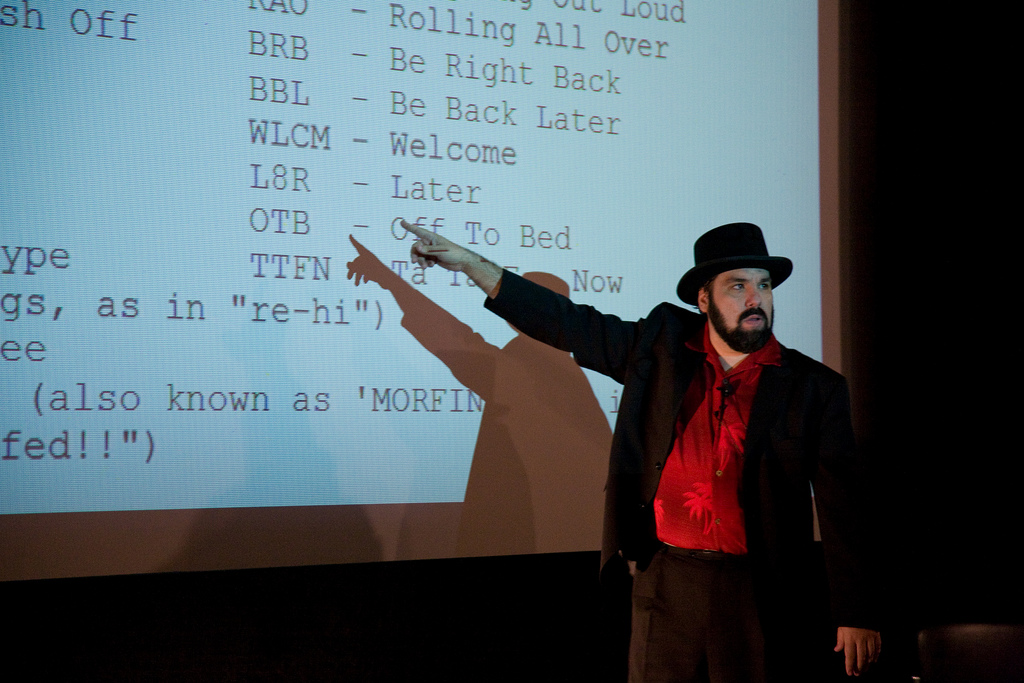
Our evening with Jason Scott last Wednesday was possibly the most entertaining archives talk ever in the world. No really. It really was. Jason is passionate and committed to his work and deadly serious about its importance but he is also seriously funny. Enjoy.

Podcast: Where do old websites go to die? Jason Scott of Archive Team (MP3, 1 hr 30 mins)

  • Introduction by Cassie Findlay: 0:00 – 6:36
  • Jason Scott’s talk about Archive Team: 6:37 – 47:24
  • Q&A: 47:25 – 1:30:00 
For a view from the audience, Bernard Debroglio from Mosman Library posted a great report on their blog: http://refdesk.mosmanlibraryblogs.com
Posted in Report | Tagged , , | 2 Comments

Where do old websites go to die? Jason Scott of Archive Team

The Recordkeeping Roundtable is pleased to announce its next event: Where do old websites go to die?, with Jason Scott, founder of the US based, self described ‘loose coalition of rogue archivists, programmers, writers and loudmouths’, Archive Team.

  • When: Wednesday June 22, 5.30 for 6.00pm – 7.00pm
  • Where: ATP Innovations Seminar Room, National Innovation Centre, Australian Technology Park, Redfern (map and directions)
  • Cost: Gold coin donation (for the nibbles)
  • To register: Go tohttp://rkroundtable.eventbrite.com/

Photo: Jason Scott

Many of us in the recordkeeping community are acutely aware of the problems attending institutional website “archiving” but the problems of preservation in the wider web world are on another scale of magnitude. Nonetheless there are brave and hardy souls out there who have taken up the task. Continue reading

Posted in Update | Tagged , | 1 Comment

Stay tuned: More Recordkeeping Roundtable coming soon

We’re planning our next event –  in June, if it all comes together (and it’s looking mighty promising). It will be in Sydney, again at the Australian Technology Park in Redfern, 5.30 for 6.00pm ’til 8.00pm latest.

So keep Wednesday June 22 free and we’ll be back soon with more information.

In the meantime, if you have embraced the Twitters, you can get updates on RK Roundtable stuff (and a lot of other things, admittedly) by following me; @CassPF.

Posted in Update | Leave a comment