
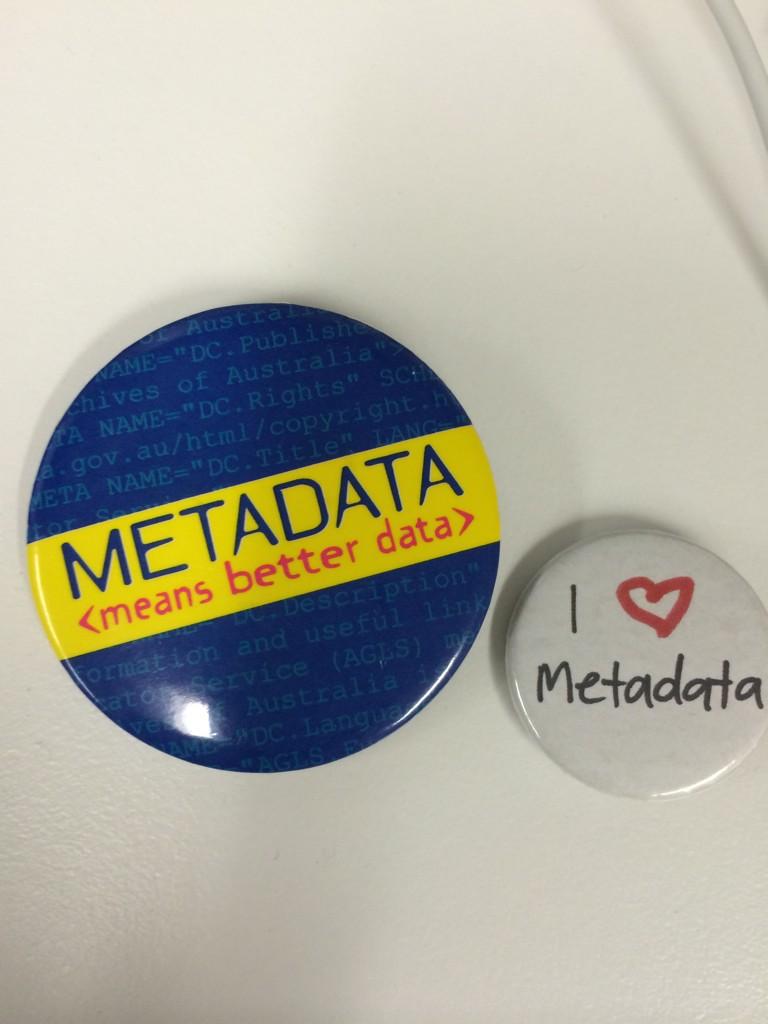
 Metadata took centre stage in the national debate this week, in the context of the Government’s data retention proposals and as a result of George Brandis’s spectacular fail when attempting to explain what exactly he meant by metadata on Sky News. Tony Abbott has spent much of the week looking nervous and pronouncing ‘so called’ metadata very, very carefully. Brandis should have been properly briefed or they should have had a cabinet member with a clue about the intertubes speak on the proposals. That is not to say that referring to what is being put forward in clearer terms would make it any more palatable. But even if he had not mangled the explanation, it is still profoundly misleading for the government to keep up the ‘don’t worry it’s only metadata’ argument in seeking to expand the scope of the collection, retention and use of our personal information. Continue reading
Reinventing archival methods: Continuing the conversation

Iris, Ayasdi’s data-visualization tool, finds connections in abstract data sets. Image: screenshot http://www.wired.com/2013/01/data-viz-ayasdi-iris/
A collection of articles and short contributions from The Recordkeeping Roundtable, our friends and colleagues, on the theme of archival reinvention.
Introduction by Kate Cumming, Cassie Findlay, Anne Picot and Barbara Reed
Articles
Dr Kate Cumming and Anne Picot ‘Reinventing appraisal‘
Barbara Reed ‘Reinventing access‘
Short contributions
Xiaomi An, Hepu Deng, Bin Zhang ‘Reinventing the Concept of the State Archival Fond in China‘
Luke Bacon, ‘A Sea of Kites: Pushing access to archives with progressive enhancement‘
Belinda Battley, Elizabeth Daniels and Gregory Rolan, ‘Archives as multifaceted narratives: Linking the “touchstones” of community memory‘
Nicole Convery, ‘From reactive to proactive appraisal‘
Mark Crookston, ‘Reinventing Archival Methods: Am I part of the problem or part of the solution?‘
Adrian Cunningham, ‘Eternity Revisited: In pursuit of a national documentation strategy and a national archival system‘
Dr Katrina Dean, ‘Digitizing the modern archive‘
Dr Joanne Evans, ‘Reflections on the Promise and Pitfalls in Reinventing Recordkeeping Metadata‘
Cassie Findlay, ‘Full docs or it didn’t happen‘
Antony Funnell, ‘Give me a serve of data with that‘
Chris Hurley, ‘Re-Inventing On-Line Access‘
Mike Jones, ‘Contrapuntal archival methods‘
Richard Lehane, ‘Building an integrated digital archives (Part II)‘
Charlotte Maday and Magalie Moysan, ‘Records management for scientific data‘
Julie McLeod, ‘Reconceptualising ERM as a wicked problem‘
Adelaide Parr, ‘In an interconnected world – why do we think in functions?‘
Barbara Reed, ‘Rethinking approaches to recordkeeping metadata‘
Sonya Sherman, ‘People telling stories‘
Dr Tim Sherratt, ‘Contexts, connections, access: the glorious possibilities of getting it all wrong‘
Kirsten Thorpe, ‘Indigenous Records: connecting, critiquing and diversifying collections‘
Andrew Waugh, ‘Email – a bellwether records system‘
Kirsten Wright, ‘Broadening the record and expanding the archives‘
Articles also available via Readlist for download to Kindle, iPad, DropBox and more: http://readlists.com/8e8b0ed1/
Introduction
Kate Cumming, Cassie Findlay, Anne Picot and Barbara Reed
When we started the Recordkeeping Roundtable at the start of 2011 [i] our aim was to start new conversations in, across, and especially, outside of the recordkeeping profession. The events we have run have reflected this; we have had guest speakers who are journalists, information security experts, hackers, digital humanists, lawyers and self-described ‘loudmouths’.[ii] We have heard from a curator of digital games concerned about their preservation and access over time,[iii] information activists testing the boundaries of Australia’s freedom of information laws and systems,[iv] a former senior public servant turned journalist who spoke about the vagaries of information access,[v] and many more. In a way, we have been having these conversations as part of a mission of self-discovery. Perhaps by understanding how others see us, and where our interests and needs intersect, we can identify how we as archivists need to evolve. Continue reading
Reinventing appraisal
Kate Cumming and Anne Picot
Introduction
In 1986 David Bearman first put the argument that core archival methods of appraisal, description, preservation and access were fundamentally unable to cope with the volumes of records archivists were required to process. He called on the archival profession to completely reinvent its core methods. [1]
Noting similar challenges in evolving digital business environments led the Sydney based discussion group, the Recordkeeping Roundtable (in partnership with the Australian Society of Archivists) to hold a two day workshop in Sydney in November 2012. This ‘Reinventing Archival Methods’ workshop was attended by nearly 70 participants from across Australian and New Zealand and included students, educators and professional records managers and archivists working in a range of government and private sector environments. [2] At the workshop participants debated and explored means by which archivists can fundamentally reassess their professional methods and determine mechanisms for the creation and maintenance of stable archival records in the twenty-first century. Continue reading
Reinventing access
Barbara Reed
In 1989 David Bearman threw virtual bombs at the practices of the archival profession. In Australia we responded to the emerging issues of digital recordkeeping influenced by Bearman’s challenging analysis. However access has long been an area somewhat neglected within the Australian recordkeeping profession. Access indeed was not a part of the AS4390 set of standards which in many ways encapsulated our professional response to digital recordkeeping in the 1990s and attempts to incorporate public access[1] within international recordkeeping standards have failed to gain professional traction.[2] Those professionals specialising in ‘reference and access,’ addressing the ‘cultural goals’, have long felt isolated and ignored by the development of records continuum thinking.[3] Another way of framing the discussion is to suggest that the concept of public access itself needs to be considered well beyond the walls of the archival institution, and that the artificial splitting of concerns about public access according to age (and custodial thinking) does not serve us well professionally. Addressing this is core to reconceptualising the access function for the future in the digital environment. Public access is not necessarily the same as access to government information, nor does it simply equate to archival access. Increasingly private organisations are embracing open data initiatives to enable public access and legislation is requiring some access to organisational and indeed, personal, data. Every individual is a key stakeholder in access to records, potentially if not always in practice – not simply the ‘users we prefer’, already trained and skilled in using our descriptive methods to enable retrieval. Our access frameworks are fragmented into multiple pieces of legislation further complicated by incompatibility across jurisdictional boundaries – while recordkeeping is increasingly location-less. Continue reading
Broadening the record and expanding the archives
Kirsten Wright
The concept of “the record” is core archival theory and archival methods. In looking at reinventing archival methods, we must ask whether the traditional notion of the record is still applicable and how the record connects and links with material not considered part of the record. Definitions and conceptualisations of what a record tend to be very broad, but I suggest that for many or most archives, the concept of what a record is – and therefore how records are collected, managed and accessed – is narrower. In examining how archival methods are to be reinvented, I suggest that a broad approach be taken and records of all types be considered. Continue reading
Email – a bellwether records system
Andrew Waugh
A bellwether is a sheep with a bell around its neck. Since sheep flock together, the shepherd could track the movement of the flock by the sound of the bell on the bellwether. In a similar way, I argue in this note that email is a bellwether records system; the problems that archivists and records managers have in ensuring that email records are captured and managed are indicative of the problems we have (and will have) in managing records from other computer/internet based systems. These problems have many causes, but one root cause is that we are still trying to manage records as if they were mid twentieth century paper files. We need to move to models of record management that address the strengths of computer/internet records systems. In this time of transition we need to accept that the resulting records produced now will not be perfect, but systems will get better if we adapt and change our advice. Continue reading
Indigenous Records: connecting, critiquing and diversifying collections
Kirsten Thorpe
The management of Indigenous records and collections presents challenges to traditional archival methods and practice. Indigenous issues relating to the management of archives are important questions that should be discussed and considered broadly by the profession. In this paper, I will draw on my own professional and personal experiences of working as an Indigenous archivist to illustrate some of these challenges.
I will suggest that a reshaping and reinvention of methods needs to take place to acknowledge the many complex relationships that exist between Indigenous people and records, and to recognise the rights of individuals and communities to participate in decisions about archival management and practices. I will first consider these issues by discussing challenges that are presented in managing existing archival collections, followed by a discussion about the opportunities that exist in the digital domain for rich and diverse collections to be created that allow for multiple perspectives. Continue reading
Reinventing the Concept of the State Archival Fond in China
Xiaomi An, Hepu Deng, Bin Zhang
A fond is the aggregation of records originated from the same source. Traditionally the concept of the state archival fond is usually referred to the aggregation of historical records with the state ownership. [i] Over the past 20 years, there is no general agreement on what the concept of the state archival fond is about. [ii] The purpose of this paper is to understand the evolution and development of the state archival fond in China and its impacts on the archival administration and to reinvent the concept for the effective management of archives for their optimal utilization in today’s dynamic environment. Continue reading
Archives as multifaceted narratives: Linking the “touchstones”[1] of community memory.
Belinda Battley, Elizabeth Daniels and Gregory Rolan
Records can help communities to construct and preserve their collective memory, in support of community values, survival and protection of rights. Records can be considered evidence[2] – not simply in the legal sense – but of individual personhood, providing validation of experience and a sense of self[3],[4]. Thus collective memory is an essential part of community and individual identity. Rebecca Knuth describes the “National Archives [as] an institution charged by the government with maintaining the documentary basis of national identity” [5], defining who belongs and who does not. The records that it holds “document the choices societies make about how they define who their people are”[6]. Similarly, Terry Cook suggests the focus of archival theory has moved from evidence to memory to these concerns of identity and community, and that the archivist has been transformed from a passive curator to a community facilitator[7]. Continue reading

 Recordkeeping Roundtable